In this post we will see how to upgrade Windows Server 2008 R2 to Windows
Server 2012. It’s been an year that Microsoft has released Windows Server 2012,
when Windows Sever 2012 was released the IT professionals were eager to know
what’s new in Windows Server 2012 and i was one of them. Microsoft releases all
of its operating systems in multiple editions, which provides consumers with
varying price points and feature sets. While choosing the edition make sure you
choose the edition that suits your requirements. Before we go ahead and deploy
Server 2012, let’s take a look at editions of Windows Server 2012.
1) Windows Server 2012 Datacenter
Edition – The Datacenter edition is designed for large and
powerful servers with up to 64 processors and fault-tolerance features such as
hot add processor support. This edition is available only through the Microsoft
volume licensing program and from original equipment manufacturers bundled with
a server.
2) Windows Server 2012 Standard Edition
– This is a fully functional edition of Windows Server
2012. Frankly speaking there is no much difference between Datacenter and
Standard Edition of Windows Server 2012. What differentiates these 2 editions
is the number of virtual machine instances that is permitted by the license. A
Standard edition license will entitle you to run up to two VMs on up to two
processors. A Datacenter edition license will entitle you to run an unlimited
number of VMs on up to two processors.
3) Windows Server 2012 Essentials – The
Essentials edition is suited for small organizations, this edition includes all
the features of Standard and Datacenter edition except the Server Core, Hyper-v
and ADFS (Active Directory Federation Services).
4) Windows Server 2012 Foundation – This
edition is designed for small businesses that require only basic server
features such as file and print services and application support. The edition
includes no virtualization rights and is limited to 15 users.
If i were to upgrade my existing windows server 2008 R2
Enterprise server to windows server 2012 i would first choose the edition and
then i would check the upgrade paths. I have created a table which shows
whether you can upgrade to windows server 2012 with you present operating
system.
Lets take a look at hardware requirements for upgrading our
server to windows server 2012. Windows Server 2012 requires minimum of 16 GB to
32 GB of disk space. When you install Windows Server 2012 it occupies 15.1 GB
of space approximately but its good to allocate at least 32 GB of drive space
for Windows Server 2012. You would require 1.4 GHz 64-bit processor, 512 MB of
RAM, 32 GB of disk space, DVD Drive, Super VGA (800×600) or higher resolution
monitor, keyboard and mouse.
In this post i will be showing
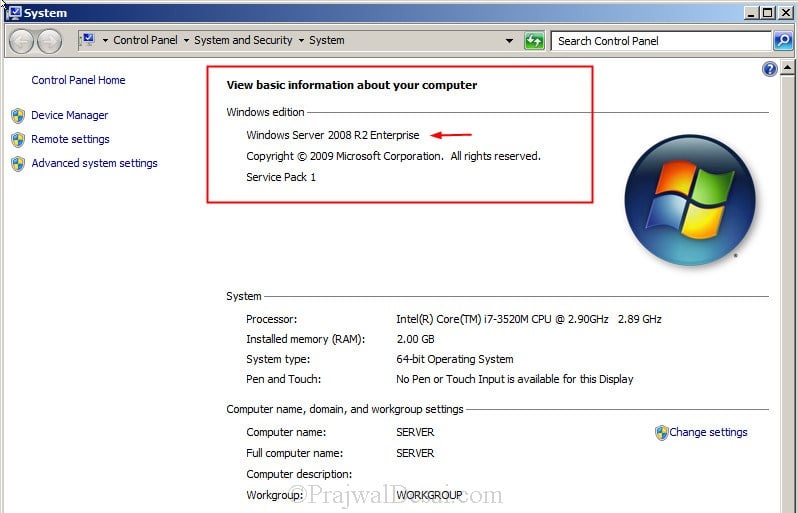
you how to upgrade a windows server 2008 R2 Enterprise SP1 to Windows Server
2012 Datacenter.
Note that the existing server
is in workgroup, do not consider this post to upgrade your domain controller to
windows server 2012. I will be creating a separate post to
show the upgrade of domain controller running on windows server 2008 r2 to
windows server 2012.
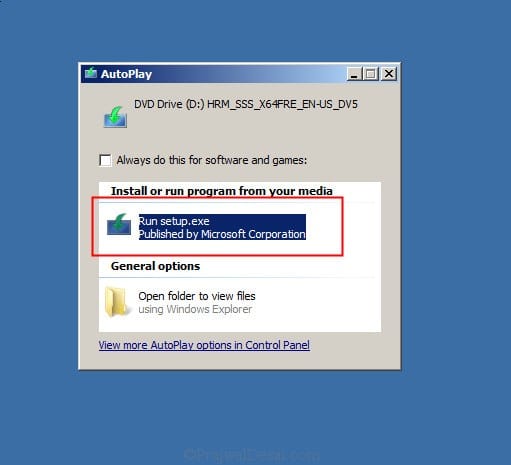
Insert the windows server 2012 DVD into the DVD-ROM and click on Run
Setup.exe.
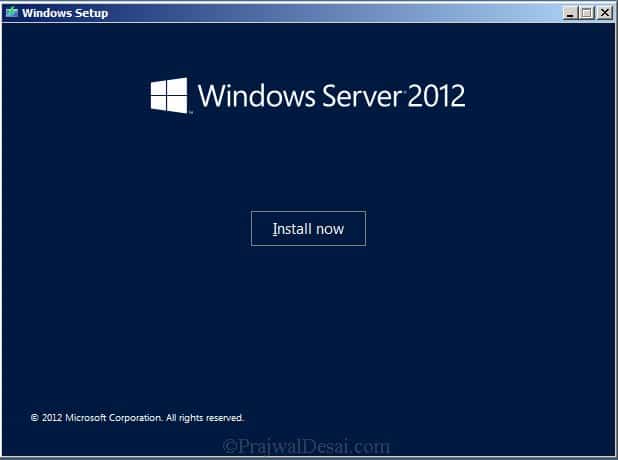
On the Windows Setup screen, click on Install
now.
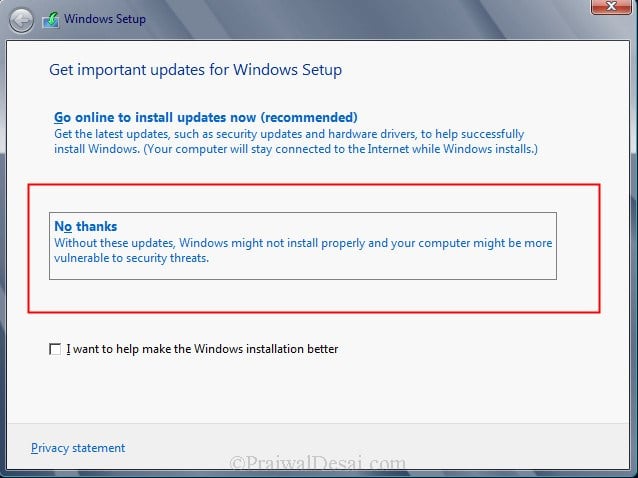
If you want to get security updates and latest drivers for your
operating system select Go online to install updates now.
We can also do a windows update once the upgrade is completed, so select No,
Thanks.
Enter your product key for windows server 2012 and click on
Next. In this step i have entered server 2012 Datacenter edition key. Click on Next.

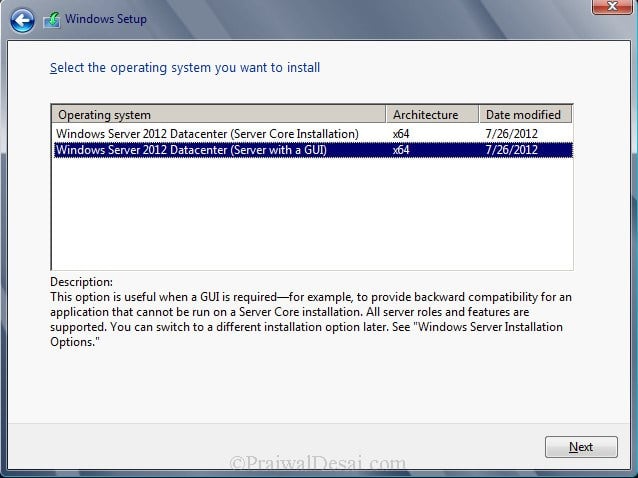
Server core installation has no Server Manager or
any other MMCs to manage roles and features. The management must be done either
remotely from a client machine or through the command prompt or Powershell at
the console. There is no Start menu, no desktop Explorer shell, no Microsoft
Management Console, and virtually no graphical applications. All you see when
you start the computer is a single window with a command prompt. In this step i
will select the second installation mode, Windows Server 2012 Datacenter
(Server with a GUI). Click on Next.
Select Upgrade: Install Windows and Keep
files, settings and applications. This will keep existing
files, settings and applications and upgrade our server to windows 2012.
The upgrade will take close to 20 minutes. Sit back and relax
until the upgrade is complete.

The upgrade from windows server 2008 R2 Enterprise to windows
server 2012 Datacenter is complete. Let’s login to the server and check for the
edition.
Click on Server Manager, Click
on Local
Server, check the properties of server. We see that the
operating system version is Microsoft Windows Server 2012 Datacenter. The
upgrade process has been completed successfully.
I mean, I know activator for windows 10 was my choice to read, but I truly thought youd have something interesting to say.
ReplyDelete